
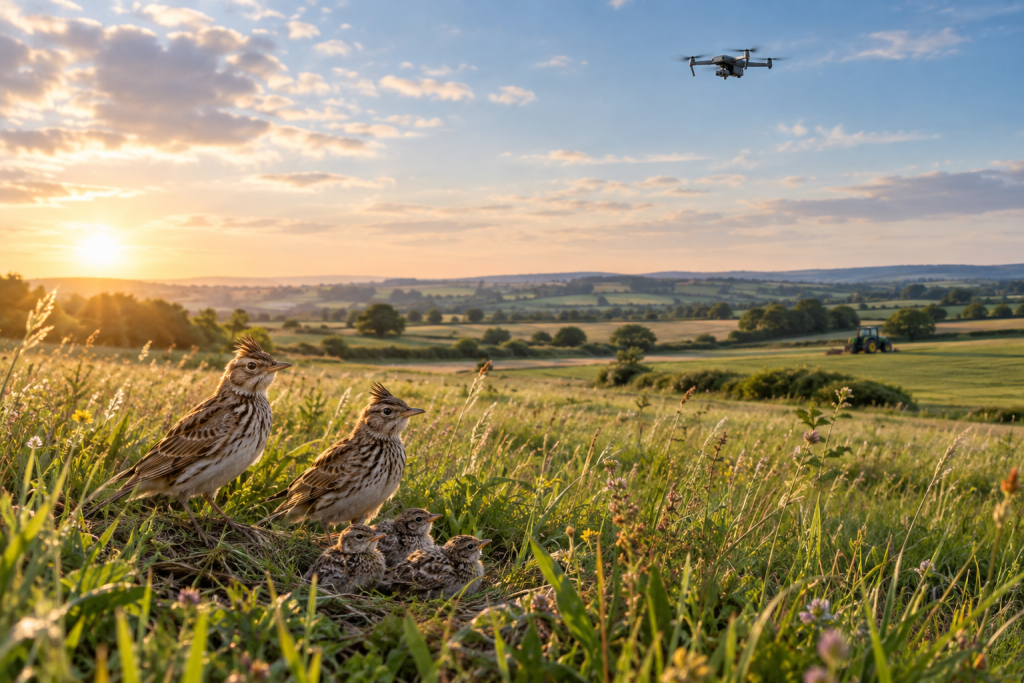

I knew nothing about skylarks. Why would I? I live in Africa and these fascinating birds live in the UK. It wasn’t until a member of the GeoWing Academy community spoke to me about what they do with their drone data that I discovered these brilliant little feathered friends.
The skylark is a red-listed species, meaning it is of high conservation concern. Their numbers have decreased by up to 75% since the 1970s. So there is valid reason to monitor these fragile species. And that is exactly what Clara Gonzalez Hernandez and Robert Wallace of Aerial Ecology are doing.
The reasons for the skylark’s drastic decline are, you guessed it, humans! Primarily, loss of habitat and habitat disturbance. Skylarks raise around 4 broods per year. These ground-nesting birds lay 3 to 4 eggs in a shallow nest bowl in open fields such as grasslands, saltmarshes, moorlands and farmlands. You can see where the problem occurs regarding the latter.
Chicks hatch astonishingly quickly, with an incubation period of only around 11 to 14 days after being laid. The chicks will leave the nest between 8 and 10 days after hatching and take cover from predators in tall grass and bushes, feeding primarily on insects (the adults feed mostly on seeds, grains and plant shoots). The chicks fledge around 16 to 20 days old and reach full independence at about 25 days. That is incredibly quick! They breed in summer, between April and August.
So if they have such a rapid breeding process, why are they declining?
There are a number of reasons. Silage for cattle is cut multiple times throughout the birds’ breeding season. The plants are heavily fertilised so that they grow fast; we need as much yield during the growing period as possible to feed the cows through winter, you see. So every time Mr and Mrs Lark have a clutch, Farmer Bill potentially and unintentionally adds scrambled egg to the roughage.
A shift from spring to winter cereal crops also hampers the birds, as areas that they nest in are too thick and dense by the time breeding season comes around.
The birds then look for more suitable areas to nest in alongside the dense fields. Unfortunately, these suitable areas are usually field margins where tractors drive and farm dogs and people walk.
Pesticides are another. Crops are sprayed during spring and summer, so the chicks have less grub. Livestock farming keeps fields too short because of heavy grazing during the skylarks’ breeding season, and eggs get trampled as well.
And so on and so forth. As human populations increase, so does the demand for food, and so other species get pressured to the point of extinction. It’s the oldest story and we all know it. There is no doubt that the odds are heavily stacked against Mr and Mrs Lark.
So what do we do about it?
We aren’t going to stop farming. We simply can’t, so don’t even start suggesting that everyone needs to grow their own food. It simply is not possible in the modern age; we will only go back to that after World War 3. And besides, farmers themselves want the best for their environment too, you must understand this. Some folks may simply argue that, “Well, farmers don’t care, they just destroy land.” This couldn’t be further from the truth.
If you have ever farmed or spent proper time with farmers, you will very quickly begin to understand how much they do care for the environment that they live and work in. They have to. Its their breed and butter. You will also come to understand just how difficult they have it in terms of trying to grow food for society, look after their land and livestock, and eke out some kind of living while navigating the never ending greed and looney laws implemented by repulsive politicians (and it’s not just in the UK). They also encounter a huge amount of resistance from certain parts of society, usually those who dont fully understand the complexity of agriculture but are trying to make the world a better place and who can blame them? So its tough. If farmers could have the skylark, believe me, most would have the skylark! There are of course those who generally dont care, but in my personal experience, these types are few and far between.
The answer, as always, lies in knowledge. The more we know about the needs and desires of the farmer, and the more we know about the needs of the skylark, the more we are able to formulate a co-habitation plan that works and benefits both.
This is what Clara Gonzalez Hernandez and Robert Wallace of Aerial Ecology in East Sussex, UK, are doing. Clara and Rob have been pioneering methods of locating skylarks in fields using thermal drones. This is a potential game changer!
Being able to map nesting sites, locate potential nesting areas and monitor chick numbers rapidly over larger fields could give observers and farmers an edge when it comes to harvesting silage, for example. If we know where the birds are right now, we can harvest the areas that they aren’t in.
If we know that the skylarks have an area of preference on a farm, that area could be rezoned for the skylarks and agriculture shifted to another area.
Habitat monitoring is also key to acquiring local knowledge. The use of a drone to find nests also reduces the risk of disturbing these ground-nesting birds. Aerial Ecology notes that the birds are not bothered by their DJI M4T at a flight altitude of 20 m above ground level (66 ft AGL).
See video here: DJI Matric 4T Finds Active Skylark Nest | Thermal Drone Wildlife Survey
Interestingly enough, a similar approach is beautifully outlined by Jeremy Clarkson and Hannah Bourne-Taylor in Episode 7 (Sickening), Season 5 of Clarkson’s Farm, filmed in 2025.
Faced with the pressure of getting the silage cut for cattle feed on one side and the desire to maintain the ecology of the countryside, Clarkson gets the show’s drone pilot to hunt for skylarks in the fields with a thermal drone before cutting commences.
Unfortunately, in the show, all they find are warm sheep turds. But remember, this was done by a pilot who usually shoots TV shows, not a dedicated conservation pilot. The concept was there, though: Clarksons Skylark Drone Snippet
The way Aerial Ecology is approaching environmental issues — information gathering and data analysis — has the potential to uncover new, missed information that could turn the tides of the skylark’s demise.
The use of drone, photogrammetry and GIS technologies in conservation is still being pioneered. The kinks are still being worked out, the applications are still growing, and the true power of these tools is still being discovered.
And that is very exciting!
To find out more about Aerial Ecology, their Skylark project and the other brilliant work they are doing please visit: Aerial Ecology